ACE scores: what an adversity count can and cannot say
Updated October 12, 2026 · Reading time: 5 min · 5 sections

Your ACE score is easier to understand when you know which questionnaire produced it. I would start with the categories you answered, then read the total alongside them. The number counts experiences; your current concerns and the support you want need their own conversation. This is general information, not individual medical advice.
Start with the questionnaire, not the total
ACE stands for adverse childhood experiences. The CDC describes experiences during childhood such as violence, abuse and family circumstances that can undermine safety. That is a public-health concept, not one universal online test. Websites can use original, expanded or entirely custom item sets. A title containing ACE does not tell you which one you are seeing.
For a questionnaire containing ten binary exposure categories, a category count can run from zero to ten. The number tells you how many of that questionnaire’s categories were marked, not how many events occurred. If a category was experienced repeatedly, a simple category count does not necessarily increase each time. If another important experience is absent from that questionnaire, it will not appear in that particular total.
Here is a purely hypothetical counting example: someone answers Yes to three categories and No to the other seven on a ten-category form. The count is 3 × 1 + 7 × 0 = 3. All ten have answers: 3 + 7 = 10. Leaving seven questions unanswered would instead give a possible range of 3–10. That arithmetic does not reveal whether the experiences happened once or repeatedly, how the person understood them, what support was available, or what is troubling them today. The total is only one summary of a specified form.
Keep exposure, symptoms and interpretation separate
| Kind of information | Example question | Limit of a count |
|---|---|---|
| Exposure | Was this category of experience present? | May omit frequency and context |
| Current difficulty | What is affecting daily life now? | Not established by an exposure total |
| Meaning | How do I understand what happened? | Cannot be assigned by arithmetic |
| Support | What help or conversation would be useful? | Does not require reaching a threshold |
I would not subtract a “resilience score” from an ACE count and call the remainder repaired trauma. Supportive experiences matter, but combining two different questionnaires needs a justified method rather than a pleasing equation. Nor would I translate a high count into a personal prediction about future illness. Group-level research and an individual assessment answer different questions; a web result should make that distinction visible.
A person with a lower category count can still have serious concerns. A person with a higher count is not automatically defined by it. Both statements follow from the limited meaning of counting categories. Comparison can be especially misleading when two people filled out different forms. Even identical totals can represent different categories and very different situations.
Read an ACE score with a small checklist
- Identify the exact questionnaire or item list, rather than relying on its marketing title.
- Check whether it asks about childhood exposure, current symptoms or a mixture of both.
- Look for the timeframe and what a skipped or uncertain response does to the calculation.
- Separate the numerical count from any diagnostic, risk or recovery claim attached to it.
- Keep a copy only if you want one, after checking whether it includes sensitive answers.
Uncertainty deserves its own place. If you cannot confidently answer an item, a responsible interface should not quietly turn that uncertainty into “no.” Conversely, it should not force you to select “yes” because an experience might have happened. A form with no uncertainty option may need clarification from the person administering it. Do not fill gaps in your memory to make the questionnaire feel complete.
Look carefully at graphs. A colored bar can suggest that an exposure count is a severity scale, even if the text does not explicitly say so. A recovery curve can imply that the website knows how quickly you will improve. Ask what data and method support those claims. Decorative precision, such as a percentage to one decimal place, is not evidence of clinical precision.
Two modes: an ACE count and optional reflection
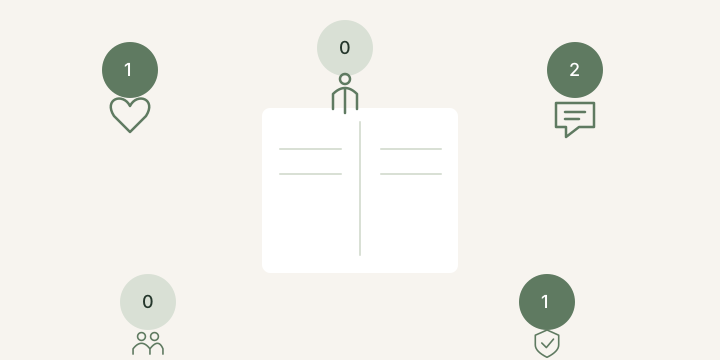
The test on this site starts with ten childhood exposure categories adapted from the ACEs Aware adult questionnaire. Yes counts one, No zero, and open responses produce a possible score range. Seven extra experiences and eight supportive experiences can be added; they are counted separately, without subtracting support from adversity. The optional reflection still contains twenty custom prompts, including present-day patterns. Its responses do not generate an ACE score: the map shows only topics you deliberately bookmarked, and completion counts remain separate from the main test result.
That separation is useful when your immediate goal is to gather language for a conversation. You can bookmark difficulty with boundaries because you want to ask about it, without claiming that an earlier event caused it. You can leave all childhood questions aside and notice a present pattern. A bookmark is your organizational choice, not evidence that a symptom meets a clinical criterion.
Consider a hypothetical person who answers five questions, skips four and leaves the rest untouched. The reflection shows 5 answered, 4 skipped and 11 unanswered. If they bookmark two questions, the topic map shows two bookmarks. There is no further calculation from those numbers. The person can still prepare one useful question for a professional or decide not to share the notes at all.
Bring questions rather than a verdict
If you discuss a result with a qualified professional, it may help to bring the questionnaire name and the specific uncertainty you have. For example: “I found this count online and do not know whether it describes my current difficulties.” That invites interpretation rather than asking the professional to confirm the website’s label. You can choose how much background to provide and ask how the information will be used.
You do not need to rehearse every experience before seeking support. A practical starting point can be a current concern, its effect on daily life and what you hope to ask. The conversation preparation guide turns those into an agenda. If your concern is a symptom checklist rather than childhood exposure, the PCL-5 explanation describes why that is a different instrument.
If you are in immediate danger, contact your local emergency service. For emotional support you can choose your country through Find A Helpline. Neither an online count nor a blank result should delay that choice. My rule for these numbers is modest: understand what was counted, keep uncertainty visible, and leave diagnosis and individual interpretation to a qualified assessment.
Common questions
Does an ACE count measure how many events occurred?
No. On a binary category questionnaire it counts marked exposure categories. Repeated events within one category do not necessarily add more categories.
Can protective experiences be subtracted from an ACE score?
Supportive experiences matter, but they do not provide a justified arithmetic correction to an exposure count. These are different kinds of information.
Why does the optional reflection have no ACE score?
Its custom questions include present-day feelings and are not ACE categories. The separate main ACE test counts ten childhood exposure categories.