Prepare a support conversation without telling every detail
Updated October 12, 2026 · Reading time: 5 min · 7 sections

You can ask for support with one sentence about what is difficult now. I would prepare one concern, one boundary and one question, rather than a report of your whole history. The examples below are hypothetical ways to start that conversation, not treatment advice.
Choose a purpose small enough to say aloud
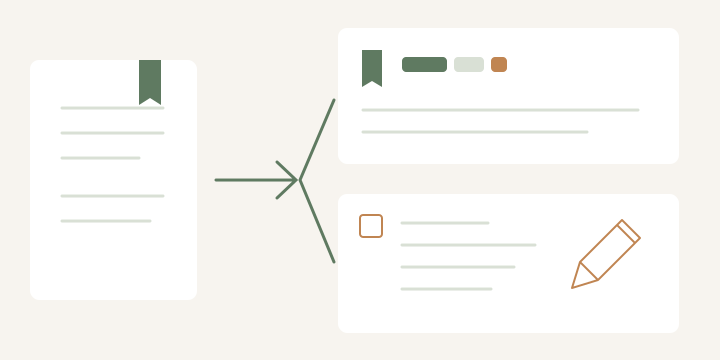
“I want to talk about how hard it is to say no” gives a conversation a clear starting point. “I want this quiz to tell me why everything happened” asks it to do something it cannot do. In the optional reflection, a bookmark means you chose a topic. It is not a conclusion that the topic was caused by childhood trauma, and it does not require telling another person every answer.
Your purpose might be information rather than disclosure. You could ask how an assessment works, what a first appointment involves or how notes are stored. You could also choose to discuss a present difficulty before deciding whether to talk about childhood experiences. A narrower opening leaves room to understand the setting and the person’s role before sharing more.
A three-part agenda
| Part | Example wording | Why it helps organize |
|---|---|---|
| Concern | I notice I avoid saying no at work | Names a present situation |
| Boundary | I do not want to describe my childhood in detail today | Makes your preferred scope explicit |
| Question | How would you assess this difficulty? | Invites the professional to explain their process |
These sentences are examples, not the correct words for everyone. You can make them less personal: “I have a question about boundaries and support options.” You can make them more specific if that feels appropriate. What matters for the agenda is separating the observation, the information you want to keep private and the question you hope to ask.
I would avoid writing a causal explanation just because it seems expected. “I feel tense in certain situations” is an observation. “My childhood caused every instance of tension” is a claim that needs more than a browser reflection. Leaving the explanation open is not a failure to understand yourself. It gives an assessment room to consider your present circumstances without treating the quiz as proof.
Prepare a small note in five steps
- Pick one present concern you are willing to mention.
- Write a brief example of when it appears, without unnecessary names or identifiers.
- Choose the details you prefer not to discuss at this point.
- Write one question about the kind of support or assessment available.
- Review the note and decide whether to keep it, copy it or take nothing at all.
In the optional reflection, a short note can be written before selecting a response. It stays separate from the answer count. That is useful if you recognize a question but cannot choose among its options. You can mark Unsure, prefer to skip or leave the prompt unresolved, while still writing a sentence you want to ask about. The tool does not interpret that sentence or assign it a risk level.
A note does not need every detail of an experience. “This is difficult to discuss, and I want to ask about support without giving details yet” is itself a possible starting point. If the person needs more information to do their job, you can ask why it is needed and how it will be used. Different services have different roles, so understanding the setting matters.
Match the conversation to the person’s role
A friend, a helpline volunteer and a qualified clinician offer different kinds of interaction. A friend may listen but cannot be assumed to provide an assessment. A helpline can offer human emotional support within its service’s scope. A clinician can explain their assessment process and professional role. Before sharing sensitive notes, ask what the setting provides rather than assuming that any supportive conversation is clinical care.
Privacy rules also depend on the service and location. I would ask the actual service about confidentiality, records and any limits instead of relying on a generic website’s promise. For a booked appointment, practical questions might include who sees the notes, whether you can decline a questionnaire and what happens if a topic feels too difficult to continue. This guide cannot state those rules for every provider.
A topic-only copy is often enough to prepare
The reflection’s default export includes completion counts and bookmarked prompts. It omits selected answers and personal notes. You can choose to include those details, but more text is not automatically more useful. Review the output yourself. A question containing sensitive subject matter may reveal something you would prefer to keep private even when its selected answer is excluded. The main ACE test has its own copy: totals are included by default, while individual answers require the separate include option.
Copying places text on your device’s clipboard. Saving creates a text file. Neither action sends anything to a service, and neither guarantees privacy after you share it elsewhere. A downloaded file remains until you remove it; clearing the tool’s answers does not remove that file or a screenshot. On a shared device, it may be preferable to keep no browser draft and use your own separate note-taking method.
Keep the opening flexible
You can begin by saying that your note is a prompt for discussion rather than a diagnosis. If you used an online test, bring its name and explain what you were uncertain about. The ACE guide and PCL-5 guide explain why different questionnaires should not be treated as interchangeable evidence. A professional can tell you whether a particular measure fits their assessment.
You can also ask to pause the conversation or return to a topic later. Preparing a note gives you a starting point, not an obligation to read every sentence aloud. If the conversation moves outside the scope you hoped for, you can restate your question or boundary. The reflection’s topic map is deliberately a collection of your bookmarks, not a checklist someone else must work through.
Do not make a quiz the gate to urgent help
If you are in immediate danger, contact your local emergency service rather than waiting to finish a form. For human emotional support, Find A Helpline lets you choose a country and browse services. The directory is external and is not emergency dispatch. You do not need a score or exported document to consider contacting support. The smallest useful preparation can be the question you already know you want to ask.
Common questions
What can I put in a short conversation agenda?
One present concern, one boundary about what you wish to discuss and one question about support or assessment. The examples are optional ways to organize a conversation.
Does a topic-only copy contain my answers?
The default export omits selected answers and personal notes. It includes completion counts and bookmarked prompt wording, which can still be sensitive.
Does Forget answers remove an exported file?
No. It clears the tool’s page session and browser draft keys. Clipboard contents, downloaded files and screenshots must be managed separately on your device.